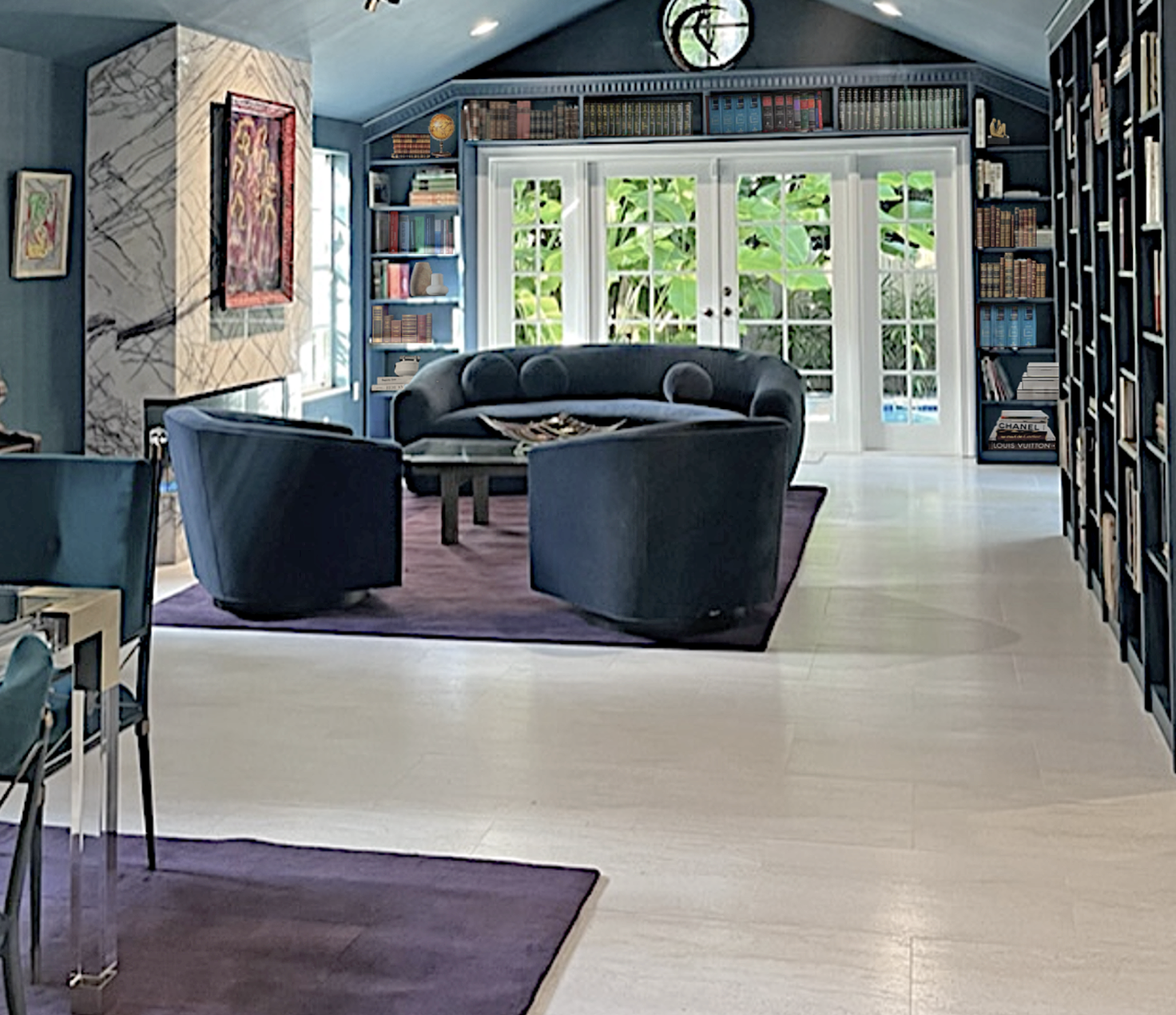
Luxury home library and sitting room remodel with custom library and purple marble fireplace, client’s artwork, and designer-selected furnishings by Exclusively To Design.
Many people still think interior design is mostly about mood boards, furniture and decor selection, fabrics and color, beautiful rooms.
That is only a small part of the work.
The real value of a designer is orchestration: translating general ideas into a smart, cohesive design solution within a workable plan, refining decisions and specifications, mitigating existing structural issues, coordinating all elements of the design and the collaborative teams that are hired to implement and execute their vision. They carry a residence from concept through completion. In a luxury condominium or high-value Miami or South Florida home, that is where the difference is made.
A designer does not simply imagine the outcome. A designer creates the outcome step-by-step.
The public usually sees only the creative portion, not the operational processes involved. That is what the client pays for.
The most visible parts of design are the ones clients see everyday: the beautiful symphony of color and material, furniture and decor and the lighting and finishing details that makes their dream home.
Yes, those are important. A designer establishes how the home should feel, how it should function, and what kind of experience it should create.
But that is only the beginning.
The deeper value of design lies in what happens after the concept exists. The designer continues shaping, editing, clarifying, and protecting that concept as the project moves through real-world pressure as it evolves through existing conditions, delays and other external factors.
Design creation and design orchestration are not the same thing
Creation is the start.
Orchestration is what takes over once the project begins to move. A lead time changes. A substitute is required. A client finds a piece independently. A room evolves. A finish reads differently in natural light than it did in the showroom. A contractor missed a detail. The size of fuirniture that looked ideal on paper needs to be refined in the actual room. A decision made in one area starts affecting another.
As the design evolves, the designer’s true value becomes visible.
A good designer does not simply present ideas. A good designer manages the project’s direction and its complexities. They keep the vision in tact as conditions change. They plan the overall design concept to keep the home from splintering into disconnected spaces. They guide all the interdependent teams and elements through each phase with clarity and direction.
That is not decoration. That is leadership.
What happens before a room ever feels complete
Before a room ever feels settled, many invisible decisions have already happened.
Scale has been studied. Proportions have been corrected. Circulation has been protected. Finishes have been compared. Visual weight has been balanced. Comfort has been considered alongside appearance. Adjacent rooms have been taken into account. Competing ideas have been edited down.
This is why sophisticated interiors feel calm. Not because less work went into them, but because more attention to detail and material discipline did.
When a residence feels natural, fluid, and resolved, that is usually the result of many aligned decisions being made early and tailored as the home comes to life throughout the project.
Execution matters as much as creativity
The design world often celebrates creativity and talks less about execution.
But a beautiful concept does not automatically become a beautiful residence. Interior design and remodeling becomes one only if someone carries it through the process with consistency, critical thinking and sound judgment, and continual follow-through.
That includes communication, coordination, decision management, refinement, installation planning, and the ability to solve problems without weakening the home.
In a Miami luxury condo, where expectations are high and the market is visually sophisticated, that standard matters even more. Clients, buyers, and renters can feel when a home has been fully carried and when it has only been partially assembled.
A designer protects more than appearance.
A designer is not simply there to make the home look good.
A designer protects the investment, the experience, and the integrity of the result. They help clients make the best choices for their needs. They oversee the construction to ensure quality and prevent small compromises that slowly erode the design’s outcome. They help ensure that what begins as a strong idea results in an interior design that exceeds all expectations.
That is why the best projects are not only creative. They are coherent.
At Exclusively To Design, we aim to solve this by orchestrating the many visible and invisible parts required to carry a residence from concept to completion. Explore our portfolio to see the results of our work. Contact us to schedule a consultation.